This week we have been asked to write about perception.
dictionary.com describes perception as "the act or faculty of apprehending by means of the senses or of the mind; cognition; understanding". http://dictionary.reference.com/browse/perception
dictionary.com describes perception as "the act or faculty of apprehending by means of the senses or of the mind; cognition; understanding". http://dictionary.reference.com/browse/perception
A more academically relevant definition of perception is “Perception is the process of sensing, selecting & interpreting consumer stimuli in the external world” (Wilkie, 1994)
My favourite definition of perception is from Wiktionary: "That which is detected by the five senses; not necessarily understood ; also that which is detected within consciousness as a thought, intuition, deduction, etc." http://en.wiktionary.org/wiki/perception
Perception is the active process of interpreting and organising sensations to produce a meaningful experience of the world. Perception differs from sensation in that sensation is the immediate, unprocessed information from one or more of the five senses; whereas perception requires further processing. (Lindsay and Norman, 1977)
I like the Wiktionary definition because what is actually perceived is not always the same as reality. What is perceived is largely influenced by mood, desire, context, gender, presentation, past experience, time and consciousness.
I would define perception as: "The subjective experience of awareness of changes or existences in reality".
Perception is the active process of interpreting and organising sensations to produce a meaningful experience of the world. Perception differs from sensation in that sensation is the immediate, unprocessed information from one or more of the five senses; whereas perception requires further processing.
I like the Wiktionary definition because what is actually perceived is not always the same as reality. What is perceived is largely influenced by mood, desire, context, gender, presentation, past experience, time and consciousness.
I would define perception as: "The subjective experience of awareness of changes or existences in reality".
The above video is actually a man's arm pit, but it managed to get 4.8 million views and counting on You Tube.
Examples of differences of perception range from colour blindness (the inability of sufferers to distinguish differences colours that others can) to sufferers of anorexia nervosa (who see their bodies differently to how other people see the anorexic's body) to the old idiom of is the glass half full or half empty? - which is sometimes used to gauge whether a person is an optimist or pessimist.
 |
| Which are you? |
http://scienceblogs.com/neurophilosophy/2010/01/desire_influences_visual_perception.php
We tried to recreate this experiment in class with quite surprising results. We asked our class to judge the distance between a line and different objects. The objects were: a green peg, a pen, a Snickers flapjack bar, a packet of tissues and a £10 note.
We expected the £10 note to be judged to be the shortest distance from the line than it actually was, as we thought it would be the most desirable object; what actually was the case was the Snickers flapjack bar was judged to be at the shortest distance. This either suggests that desire does not affect perception in the same way for everyone or at 9 am on a Friday morning a Snickers flapjack is more desirable than £10!
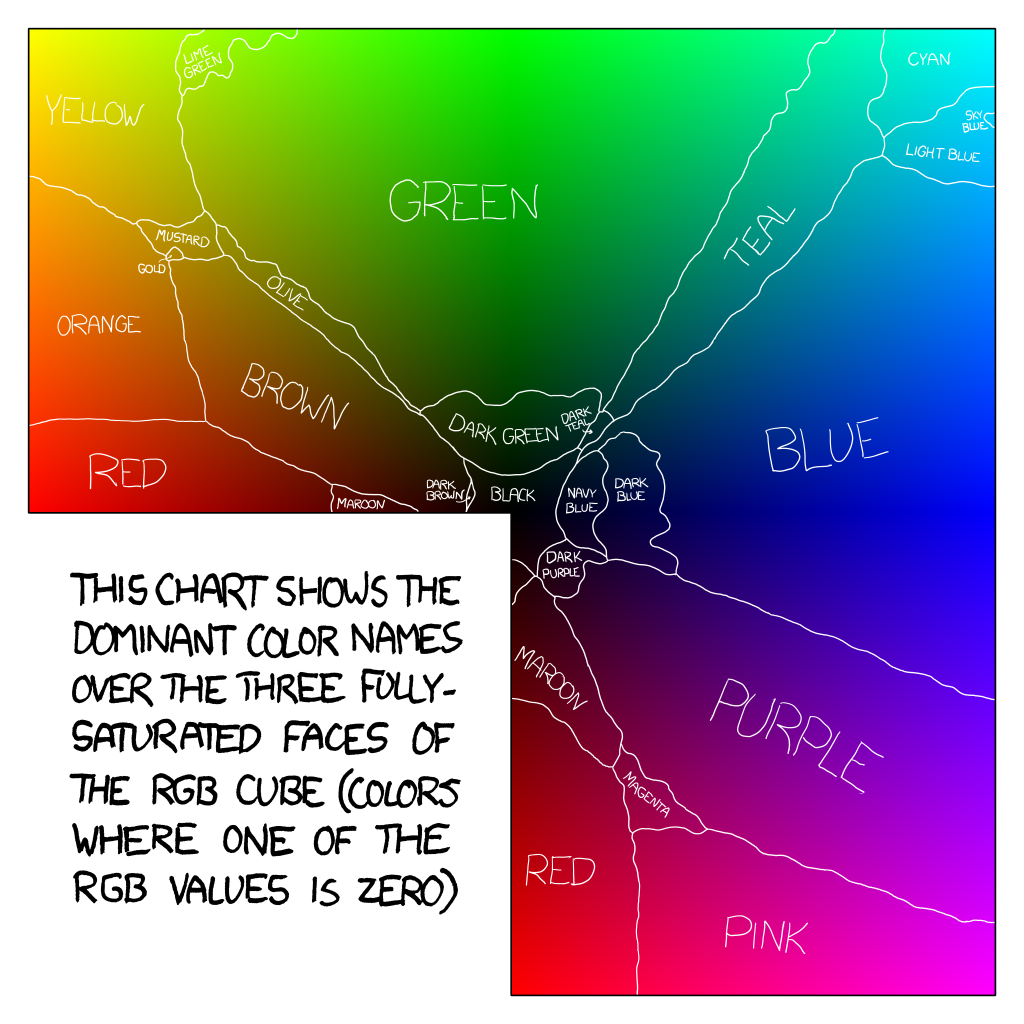
Randall Munroe subjected readers of his XKCD web comic to a fun and informative survey on color perception and categorization between males and females. The results are both surprising and amusing.
http://blog.xkcd.com/2010/05/03/color-survey-results/
The results show that women use more modifiers for colours than men do (e.g. hot pink, light green) but generally there is an agreement on what name we call each colour. Here's a chart of the overall results:
and finally a quaint quote on the subject:
"It is one of the commonest of mistakes to consider that the limit of our power of perception is also the limit of all there is to perceive."
C.W. Leadbeater
Great start but your web links aren't working - could you look at them?
ReplyDelete